The number of Team Divisions and the number of teams in each division will be determined at the beginning of each season after all home courts have been declared. Teams will be organized in the divisions in sequential order from highest to lowest based on over-all team averages from the previous year by the statistician. New team’s division placement will be determined by the board of governors (captains).
b.
The Board of Governors (captains) will submit at the January meeting any complete scheduling format, including or excluding playoffs. (Ie; play in div teams once, twice, have knockdowns, etc.) That has been submitted during the February meeting.
c.
The schedule format is to be voted on, then created between the February and Second March meeting when it will be reviewed and approved for the season.
Section B- Franchise and Roster
B-1.
Annual franchise fee of One Hundred Thirty dollars (non-refundable) will be required to enter the Garden State Horseshoe League. Entering deadline will be closed at the regular February meeting.
B-2.
All new teams require a one-time $60.00 deposit for horseshoes (3 sets), refundable when the team disbands and the shoes are returned.
B-3.
All teams must declare their home field sites for the upcoming season by the January meeting, any team that requires a change after that meeting may cause a conflict in the schedule. If this happens rather than revise the entire schedule, just the 1 teams schedule will be revised which may result in more or less home/away matches and/or matches played at a neutral site.
B-4.
Rosters can be revised up to the May meeting, (final roster change), any team adding or changing a player must notify the league statistician by phone and by noting the change of players on the consolidated sheet. Captains must also notify the opposing team captain before the start of the match. (up to the start of the match). No roster changes can be made after the start of the match NO EXCEPTIONS. Any player added to a roster will remain on the roster the entire season and any player removed from a roster will remain off the entire season. Any player added to a roster during this grace period (from start of season to final roster change) must qualify under the full season requirements for post season play (play-offs) and post season awards. No player can be on more than 1 roster at a time during the entire season.
B-5.
Each player will have a number given to them by the team captain with a maximum of 16 players on their roster. The team captain will submit these to the league. There will be no changes or substitutions unless done by the league statistician, which in turn will notify the league.
B-6.
Team names will be submitted to the League with the rosters.
B-7.
Any player who throws a shoe for a team in an official GSMHL match is no longer eligible to play for any other team in the league until the following season.
B-8.
A team may not play at a bar that kicked out another team until the following season.
B-9.
If a team is forced to change their home field after the season has started, the team must play “away” at the opponent’s field or at a neutral site with walkways and lights.
B-10.
All teams must have their own pits. It is all right to share pits with league approval
Section C: Match Rules and Procedures
Format of Match
C-1.
Forty-five (45) minutes before each match NO PRACTICE GAMES should be played on the pits. Each team shall be given a half the courts to practice on by this time. All pre-game practice shall be done by 6:45 PM and home team must take the next 10 minutes to prepare the pits for the match. Teams then have until 7:00 PM to put men on the pits. This is to avoid late starts.
C-2.
Starting time of games will be 12:30 PM on Sundays, and 7:00 PM on Wednesdays - ALL GAMES ARE REQUESTED TO START ON TIME.
C-3.
All dirt in pit areas will be turned over by shovel, before the start of the match, unless both captains agree not to. Watering of the pits will be the option of the Home Team. All teams will help maintain the pits for good playing conditions.
C-4.
All matches must be completed, unless prevented by Acts of God.
C-5.
Teams must play when scheduled to play, the only exception will be an Act of God. (see section G for definitions)
C-6.
Eighteen (18) games equal one match
C-7.
Pitching alternate shoes (each player takes turns pitching 1 shoe at a time) is the default for individual game play. If captains agree, consecutive shoes (each player takes turns pitching 2 shoes at a time) may be thrown for all 18 games.
C-8.
No Match can end in a tie (See section J)
C-9.
All team matches will be played in three (3) game sets (with exception see C-9) after the 3rd set there will be a halftime of no more than 20 minutes,
C-10.
The 18th Game may be called by either team which has 2 benefits.
a.
The team calling the 18th game must use an eligible player from the 16th or 17th games. Player or players being held will be announced prior to the start of the 16th and 17th games. The visiting team will choose the pit for the 18th game to be played on.
b.
Calling the 18th game to designate that you are matching up teams that have played previously in the match (see C-17). This is only allowed in the last round and can only be done on 1 pit.
C-11.
The visiting team shall place their sets on the pits first, using the designated “Who’s Up Next” sheets provided to the home team prior to the start of the round. The home team shall then place their sets on the pits.
a)
If the visiting team assigns players to pits different from those listed on the submitted sheet after games have officially started (i.e., scoring shoes have been thrown), each affected pit shall be declared an illegal game and scored as a 6-point win for the home team.
b)
If no scoring shoes have been thrown (practice shoes only), the visiting team must correct the player placements to match the submitted sheet.
c)
In the event of a disagreement regarding pit conditions, and no mutual agreement can be reached, the home team shall have final authority.
C-12.
Teams have five (5) minutes to put players on the pits. (Please be patient with this 5 min time limit as the handicap has slowed this process).
C-13.
Home team will shoot 1st and decide which player is to throw the first shoe at all matches to begin game.
C-14.
When a Home Team is forced to play @ the Opponent’s Field because they are unable to use their field
A home team may be forced to play at an opponent’s field when they share pits with another team. The team they share pits with may have a better record and is also scheduled to play that day on their home pits. (E.g. knock-downs )
•
The Team with the better record will play on their home field.
•
The other Team will play on their opponent’s field as “Home Team on paper only”
•
They will set up 2nd as if they were home and throw colored shoes.
•
The actual Home Team will be responsible for taking care of pits and supplying refreshments.
•
The actual Home Team will also derive the benefit of selling the 50-50’s
Also note: when 2 teams play on a neutral set of pits…the team who is scheduled to be home team…will be the home team in the game. They will be responsible for the pits, refreshments, 50-50 etc. regardless where the game is played.
C-15.
No one (1) man can play more than four (4) games in one given match.
C-16.
Two or three players equal one set. Sets cannot be split once a match has started. (Emergency conditions approved by opposing captains.)
C-17.
Each player can throw two (2) warm-up shoes before each game. NO practicing on game pits during the match, except on the practice pit provided.
C-18.
Two players, (set), cannot play same two players a second time during the Match except Game 18 - (See Section C9).
C-19.
NO player may participate in any other activity during an official horseshoe match.
C-20.
A team is officially on the pits when they throw their practice shoes (all four (4) players).
Scoring of the Match
C-21.
Scoring points will be applied by the following:
Game won by:
2-3 pts is scored 1 point
4-6 pts is scored 2 points
7-10 pts is scored 3 points
11-14 pts is scored 4 points
15 or more pts is scored 5 points
*21-0 and 21 or more points to 0 are shutout games and scored 6 points
Games must be won by 2 or more points.
C-22.
Both teams must keep a Master Score sheet at each match.
C-23.
All teams will use the League standardized Master Score sheet and Standard Score sheet.
C-24.
All columns of the Master Score sheet and consolidated must be added up on the sheet, then checked for any errors.
C-25.
Each home team will supply 3 score keepers, 1 for each pit in play. Each visiting team will supply 3 score keepers, 1 for each pit in play.
C-26.
Score keepers must stay together at all times on the home team’s side of choice during a game.
C-27.
Score keepers are to compare score sheets at the end of each game for accuracy, once the score keepers agree on the final score of the game, that game is final and to be entered into the master sheet as is. No attempt to correct the sheet is allowed.
C-28.
Only the players participating in the game and the official scorekeepers are allowed in the playing area.
C-29.
The league will keep statistics on Ringer percentage for each player ONLY. Shoes then must be recorded on the Master Score sheet.
C-30.
Any player may measure for a ringer: One from each team.
Fouls
C-31.
No contestant shall touch his own shoes, or his opponent’s shoes after they have been pitched until the final decision has been made as to the values of the shoes. Failure to comply with this rule shall result in both shoes of the offender being declared foul. And his opponent shall be entitled to as many points as the position of his shoes should warrant.
C-32.
If a shoe is being measured for a ringer and inadvertently is moved, the ringer is no longer possible, however it is still eligible to be considered for a single point, if determined it was the closest to the pin. Note: Teams should only measure their own shoes and not the opposing teams.
C-33.
A player’s foot may butt the inside of the foul board and not touch the top while delivering the shoe.
C-34.
No one shall call a foot foul during a game, this includes (players, Captains/Co-Cap/Alt Cap, and scorekeepers, spectators) captains are to be notified after the game who will then notify the offending player, failure to do so will result in an illegal game by the accusing team. 6 match points will be awarded for that 1 game being played to the accused team.
C-35.
Players in the pit or team Captains only can call fouls from incoming shoes (includes Co-Captains and Alternate Co-Captains).
C-36.
All problems that occur on the playing field that cannot be resolved by the Captains will be brought before the League Board of Governors. (NO game will be canceled or short-lived due to any disagreements).
C-37.
Any shoe hitting the walkways will be a foul.
Section D –Handicap Rules & Procedures
:
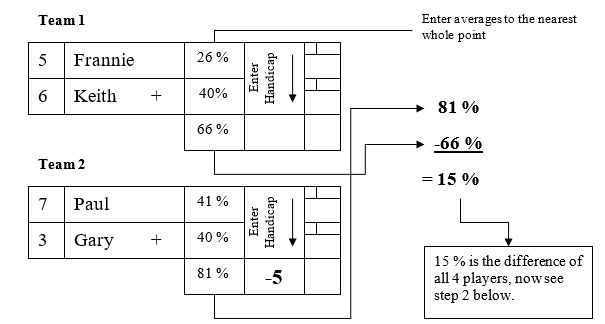
Step 1: Determine the percentage difference
Team 1 Total Percent (add the percentages of both players that are to play)
Team 2 Total Percent (add the percentages of both players that are to play)
= ? The difference in percentages
Example: Sample score sheet
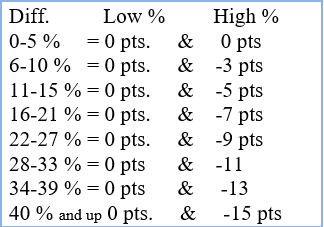
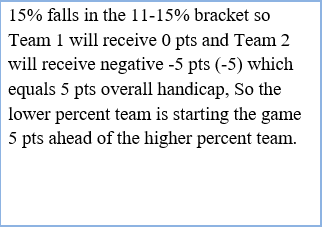
Step 2: Check the chart on the score sheet for the appropriate handicap and enter it in the correct box. (See chart below)
In-Game Handicapping Rules
D-1.
A Maximum of 15 points will be given. All handicap Points will be given to the High Avg. team as a negative value. -15, -13 -11, -9, -7, Etc. The low avg team will have to score 21 pts first to win.
D-2.
Regular Garden state league match point scoring applies
D-3.
Player averages will be entered to the nearest whole number. The Statistician will determine this. Example: Below .5% round down, .5% and above, round up (36.3 = 36, 36.5 = 37)
D-4.
Ringer averages from the end of the previous year will be used for each players first 100 shoes, including individuals starting at roster change (with new player exceptions; see rule 5), the next match after 100 shoes thrown is reached; current ringer averages will be used for the remainder of the regular season.
D-5.
New Players with unknown ringer averages will use a Default Handicap Ringer Average for the first match, after which the handicap average will be changed for the individual for the second match using current results.
Notes: 1. The Default handicap average will be the total league average from the previous year.
2. The Short Distance Players Default handicap average will be the total league average from the previous year for only the short distance players.
D-6.
End of season averages will be used through the play-offs for handicapping.
D-7.
If a Master and or Consolidated sheet(s) is not turned in on time, regular GSMHL fines and penalties apply. The averages from the previous week will be used for the next match.
D-8.
Each team captain will be required to bring a copy of their list of player averages and their opponent’s list which will be made available to all teams, either by email or the first1on.com website.
D-9.
Home teams will place players on the pits second. (The home field advantage)
D-10.
12 games are official.
D-11.
A match that is official will use the match point totals from the point at which the match was stopped.
D-12.
All new players that do not have an average from the previous year will start with a Garden State Horseshoe League average of all players from the previous year with exception to short distance players which will use the short distance player’s average. This will be for their first week only. Once they pitch in a match they will establish their own average. The league averages will be determined each year by the League Statistician. (See Section A Handicapping rules for more info on this) Players returning to the league within the last three years will use the average last recorded. Any Players that are returning and have been out of the league for more than 3 years will use the Current Default Ringer Average.
Section E: Court Specifications
Pit Layout Diagram 1
The Pits
E-1.
Pits must meet the specifications above before the start of a match including the practice pit. If a pit fails to meet the requirements above an alternate pit may be used in its place as long as it is in spec. If an alternate/practice pit is not available to use for match play, all games to be played on the unqualified pit will result in a 6 match point penalty for each game not played on the pit (36 pts)
E-2.
All Teams must have 3 league playing courts and 1 practice court that must meet league specifications. (4 Pits Total)
E-3.
Teams must use wooden or concrete walkways. Walkways will be 6 feet long by at least 18 inches wide with toe boards at the front edge above the level walkway 1”-1.5” high. .(See Diagram 1)
E-4.
Incline from pit to pit cannot exceed 4 inches. .(See Diagram 1)
E-5.
League pits are required to have backboards for the safety of the player and spectators. Backboards are to be a minimum of 2 feet high by 6 feet long. Backboards shall be a minimum of 2 ½ - 3 ½ feet behind each rear foul board.
E-6.
Each pit must have a front foul board 3 feet in front of the stake.(See Diagram 1)
E-7.
The pit shall have a front foul board it should be 2X6 or 2X8 or 4X4 boards, Foul boards shall not extend more than one inch above the level walkway. .(See Diagram 1)
E-8.
All courts must have lights installed with acceptable lighting to play the game of horseshoes on all pits.
E-9.
All courts must also include level standing surface (concrete, patio paver, wood) for 35ft shooters
The Stakes
E-10.
Stakes on court are 40 feet apart measured from the front base of each stake (39’ 11” minimum and 40’ 1” maximum) courts must be at least 10 feet apart (stake to stake). Four courts are required to play a match. .(See Diagram 1)
E-11.
Stakes will be made of solid iron or steel and approximately 36 inches long, and 1 inch in diameter, with no more than a two-inch incline towards the players. Height of the stakes will be 14 inches minimum and 15 inches maximum, from the top of the foul board on each side of the stake (not the toe boards).All pit pins must be painted white. .(See Diagram 1)
The Horseshoes
E-12.
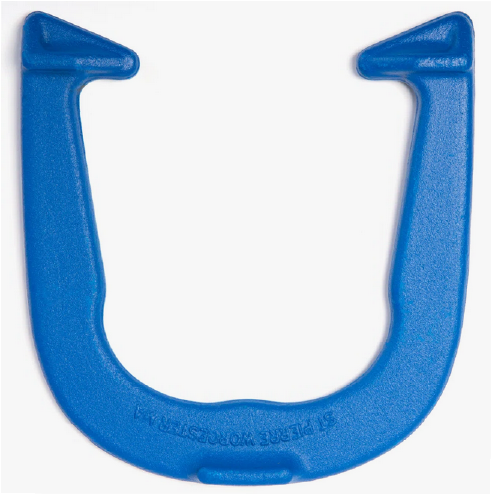
Model American AS-2 horseshoes will be the League’s official horseshoes (these shoes will be supplied by the League).
E-13.
One half or 6 shoes will be supplied by home team. Each team will have three (3) full sets given to them from the League. Bring all team shoes to each match. Home team and visiting team shoes must have contrasting colors. Home team pitches any 1 solid color except white (this means there can be only 1 color of paint on the shoes, whether it’s on the tips, on the grip areas or on the whole shoe 1 COLOR ONLY), away team pitches white.
E-14.
Every team captain will be responsible for League shoes.
E-15.
All playing fields will be inspected by a league officer one month before the season starts and must pass league requirements by the 2nd pit inspection. A 2nd pit inspection will be held before the start of the season. Any and all teams sharing the pits who fail this pit inspection, will receive a 5 match point penalty for week 1 and will continue each week until the pits pass inspections by a league officer. (who does not play at the failing pits)
Section F: Refreshments and 50/50
F-1.
Home team will purchase and supply refreshments for matches scheduled at their courts. All costs will be the home team’s responsibility. Each team will be responsible for collecting money from their team members to pay for refreshments for each home match.
F-2.
The home team will supply either 132 cans of beer or 1 keg. (Example: 5 1/2- 24 can cases, 4-30 packs+ 1-12 pack)
F-3.
If cans or bottles are provided, the home team must supply at least two different brands.
F-4.
Refreshment money collected from spectators belongs to the home team
F-5.
If home teams supply a 1/2 or 1/4 keg cups must be included
F-6.
If a 1/4 keg runs out before the match is over, arrangements must be made by the home team, in agreement with the visiting team, to supply additional refreshments.
F-7.
The home team may conduct a 50/50 drawing and an optional Ringer Pot at each match. ticket prices shall be set by the home team.
Section G: Procedures for Games Called Due to Inclement Weather Conditions
Event Definitions:
a)
Mother Nature Event: Is considered as: Rain (any), Thunder, Lightning
b)
Darkness Event: Is considered as: an unexpected failure of lighting during a nighttime match
c)
Stoppage of play: Is considered as: individual games in progress and/or stopping of the overall 18 game match
G-1.
Authority to Reschedule Matches
•
When matches are postponed due to inclement weather, only a team's captain, co-captain, or alternate co-captain from each team has the authority to reschedule the match.
G-2.
Pre-Match Agreement- (Rainout)
•
Before the match begins, captains must agree to play or the match will be postponed (see Section C-19). Regardless of weather conditions, all teams must report to the match site. A decision on whether to play will be made by the team captains at the match site. Captains may also decide to postpone the match earlier in the day.
G-3.
Completion and Make-Up of Matches
•
Matches not completing 12 games will be played over as a make-up game. Matches that have completed 12 or more games will be considered a completed match, with the team ahead at that point declared the winner.
G-4.
Make-Up Matches Schedule
•
All regular season matches postponed due to inclement weather must be made up on the first available non-scheduled, non-holiday Sunday (e.g., Memorial Day). Any player who was not on the roster at the time of the postponement will not be eligible to play in the make-up game. Captains may agree to make up the match as long as it is made up on or by the first available non-holiday non-scheduled Sunday (e.g., Thursday, Monday, etc.). Stats currently available will be used for the makeup match; contact the statistician at least one day before the match to verify both teams are using the same stat printouts. Both teams must show up on the postponed Sunday or receive a forfeit.
G-5.
Cost of Refreshments
•
If a match is postponed after it has started but is not official, teams will split the cost of refreshments evenly. The only exception is if both teams agree that the refreshments can be saved for the make-up match.
G-6.
Game/Match interruptions due to Mother Nature or Darkness Events
1.
Play may only be stopped with the face-to-face agreement of both team captains.
2.
If play is stopped, a 30-minute countdown begins. If conditions remain unsafe after 30 minutes, play will not resume unless both captains agree face to face. If Captains do not reach an agreement and rain is still falling from the sky the match is to be postponed.
3.
Any match stopped with fewer than 12 games completed will be rescheduled.
4.
Matches with 12 or more games completed will be considered official, with the leading team declared the winner.
Section H: Procedures for Forfeits
H-1.
Each team must have six players to start the match, and must have nine to start the third round (Games 7, 8, 9,)
H-2.
Any team which forfeits a match will be subject to the following penalties:
First offense $50.00 fine
Second offense $50.00 fine
Third offense $50.00 fine & review by League
H-3.
Refreshments will not be supplied unless each team has nine shooters present. If refreshments are supplied and the match is forfeited, the home team will absorb the cost, unless both team captains agreed to supply refreshments before all shooters arrive. Then, Teams Split the cost 50/50.
Section I: Championship Playoffs/Knockdowns
I-1.
All playoff alignment will be decided at the beginning of each year including refreshments and 50/50.
I-2.
Players must have played in 51%, or more of matches, at least one (1) game per match. (One more than half of scheduled official matches during the regular season).
I-3.
Record all players who did not play in match on the Master Score sheet. Attending players that did not play will be credited for the match as long as they were present for three (3) rounds.
I-4.
All post-season matches must be a complete 18 game match. Any post-season match shortened by inclement weather must be completed before or at the start of the next match. Once a match is started all scores count and get carried over to when the match is completed. If a match is never started then the match will be played on the next wed. or sun., whichever comes first.
Section J: Illegal Games
An illegal game is any of the following:
•
A player in more than four (4) games in a match. (See 19th game exception)
•
Breaking up a 2 or 3 man set after they have been established.
•
Using a non-roster player.
•
A player calling a foot foul during a game.
The penalty shall be six (6) match points for each illegal game. All individual scores from the other team will count. If a non-roster player is the 9th man for a team the match is forfeited and no scores will count.
Section K: Tie Breakers
K-1.
Regular Season Play
a.
No Match will end in a tie.
b.
All tied matches shall be decided by a 19th game. Players may play a 5th game (19th game only), but sets cannot be broken.
K-2.
Post Season Playoff Play
a.
Tie Breakers for League Standings and Playoff placement
DIVISIONAL STANDINGS TIE BREAKER RULES
The following tie break rules apply to the entire season for proper standings placement
….. If 2 teams in a particular division, have the same records, the following tie-breakers apply.
1.
Head to Head. (did either team win both games during season)?
2.
Best overall division record. (did either team win more games in their own division).
3.
Net points. (of the teams 2 games played versus each other who won by more points).
4.
Higher ringer percentage of the 2 teams advance
5.
Coin flip.
……If 3 or more teams tie, the tie-breakers will be as follows
1.
Best head to head record among the 3 teams. (did any one team beat the other more than the others). example; one team 3-1, one team 2-2, and the other 1-2. the team that went 3-1 would win division.
2.
Best overall division record.
3.
Net points.( which team had the most points scored over what they allowed in all games among all tied teams.
4.
Highest ringer percent.
5.
Multiple coin flip.(flip a coin for each team, the team which coin is opposite of all the others wins. this is repeated until a winner is determined).
Tie breakers for teams fighting for a playoff spot (wild cards)
…… If 2 teams are going for a spot.
1.
Head to Head
2.
Net points.(if the teams tied played twice and split their games than who won by more points determines winner
3.
Higher ringer percent.
4.
Coin flip.
…….if 3 or more teams are tied, use the same formula as division
1.
Winner- tie-breaker, except, eliminate step number 2.
Season Home Field Rules
When a Home Team is forced to play @ the Opponent’s Field because they are unable to use their field
A home team may be forced to play at an opponent’s field when they share pits with another team. The team they share pits with may have a better record and is also scheduled to play that day on their home pits. (E.g. knock-downs)
The Team with the better record will play on their home field.
The other Team will play on their opponent’s field as “Home Team on paper only”
They will set up 2nd as if they were home and throw colored shoes.
The actual Home Team will be responsible for taking care of pits and supplying refreshments.
The actual Home Team will also derive the benefit of selling the 50-50’s
Also note: when 2 teams play on a neutral set of pits…the team who is scheduled to be home team…will be the home team in the game. They will be responsible for the pits, refreshments, 50-50 etc. regardless where the game is played.
Section L: Game & Non-Game Related Situations
L-1.
All non-game related situations will be voted on, individually, by the Board of Governors as a precedent to this section on a “Pass”/”Fail” basis.
L-2.
NON-game related fines are a standard $20.00
L-3.
All game related fines shall be six (6) match points.
Section M: League Statistician Rules
M-1.
Both teams, winning and losing, have 2 days to supply their completed and checked official master and consolidated sheets to the statistician.(via fax, email, hand deliver, overnight mail)
M-2.
There will be no exceptions to this except in an extreme emergency, which will then be discussed by the 4 presiding officers.
M-3.
PENALTIES: Errors on and/or Late or no official master and/or consolidated:
•
1st Offense: $20 statistician awarded fine, payable to the statistician. This applies to any mistake including score error, incomplete paper work, missing info, any errors on your master or consolidated sheets.
•
2nd Offense: $40 statistician awarded fine, payable to the statistician and a 5 match point penalty.
•
3rd Offense: $40 statistician awarded fine, payable to the statistician and a 10 match point penalty.
All subsequent offenses: Will be $100 league fine and if the team won they will receive a loss for that match (see L-5). If the offending team loss the match they will receive a 20 match point penalty for the next match.
M-4.
Any Team who receives point penalties on the last week of the regular season will result in a first offense penalty (5 Match points) for the first match of the following season, regardless of how many previous offenses may have occurred during the that season of play.
M-5.
There will be no arguments. All penalties are non-negotiable. Any forfeit imposed under these rules would only give a loss to the forfeiting team. The opposing team would not receive a win. This would also make it possible for two teams to receive a loss for a match.
M-6.
The statistician will report all errors and penalties at the league meetings.
M-7.
Penalties will be assessed the same way as penalties for late or missing master and/or consolidated sheets. They will be assessed against the penalized team and not added to the other teams score. There will be no arguments. All penalties are not negotiable.
M-8.
A team who plays a team that has been penalized will not benefit from this penalty, the match will be played as normal and the penalty points will be assessed at the end of the 18th game. There may be 2 losing teams if the penalty drops the winning team’s total match points below the losing team’s total match points.
Section N: Post Season Awards
N-1.
All awards are contingent upon the League agreeing to award them each year.
N-2.
In order to be eligible for post season play and post season awards (with exception of highest average award and most improved awards (see Section N-3 and N-4)), players must play 1 more than half the available games. Example: 17 matches in a season, 4 possible games in each match (17 x 4 = 68), 68 possible games divided in half is 34 plus 1 more than half, equals 35 games needed to qualify. Players added to rosters at the final roster change meeting only will only need 23 games (11 matches times 4 games a match equals 44 available games, divided in half equals 22 plus 1 more than half = 23.) Any players added before final roster change meeting fall under full season requirements. (see section B-3)
N-3.
To be eligible for the highest average award, players must qualify under rule Section N-2 and also have played in 75% of all available matches for that season. Example: 17 matches in a season requires at least 1 game played in 13 matches, players added at final roster change meeting ONLY will only have 11 matches available which will require at least 1 game played in 8 matches.
N-4.
To be eligible for the most improved player award players must qualify under rule Section N-2 and also have played in 75% of all available matches for that season and the previous season. (See example section N-3)
N-5.
The champion team of the prior year must bring the championship trophy to the championship round match, the following year. If they fail to bring the trophy they will be subject to a non-game related fine.
Section O: Official Horseshoe Playing Rules- Game related
O-1.
Pitching distance will be forty feet, measured at the front of the stakes where they enter the ground that is level with the walkway.
O-2.
Seniors 70 years old and up may pitch between 35 to 40 feet, players that were shooting at the short distance prior to the 2016 season are grandfathered in and can remain at the short distance.
O-3.
Exceptions will NOT be permitted for players under 70 years of age for any reason to throw from a shorter distance. Players that have been previously approved for medical reasons are grandfathered in and will be allowed to continue to throw from the under 40ft distance until further notice.
Short Distance Player Rules 70+:
a.
New pitchers to the league that are eligible and wish to pitch at the short distance will start with the short distance handicap average for the first match only then use their current handicap average for the rest of the matches.
b.
A foul line must be clearly established prior to the match 32 ft. from the opposite stake.
c.
Players who become eligible or are already eligible (Turn 70 years of age) during the season that have been throwing at the full distance and wish to pitch at the short distance must:
i.
Notify the statistician at least 1 week prior to start of play at the short distance so there is sufficient time to set the player up in the master stats, pitchers must be listed with the correct handicap average on the stats sheet before they can throw from the short distance.
ii.
Use the short distance handicap average or their current average (whichever is higher) for the first week only (determined by the statistician) and use their current handicap average afterwards.
d.
Short distance players must qualify for the playoffs (have at least 1 more than half the available matches throwing at the short distance) if not they will have to throw from 40ft if they qualify for the playoffs with the overall matches attended.
e.
The current pitcher’s handicap average will be used for the remainder of the season even if the player decides to move back to the 37ft foul line (40ft foul line distance).
f.
A foul line (painted) or portable toe board must be clearly established prior to the match 32 ft. from the opposite stake on the pit to be thrown on. All toe board/foul line rules apply to this distance (section 0-9/0-10)
g.
Short distance pitchers can shoot on any pit, caution must be taken when returning to the walkway on any pit after a shoe has been pitched.
O-4.
A regulation game shall consist of 21 points.
O-5.
Each game is divided into innings and each inning constitutes the pitching of four shoes. Each player will pitch two shoes alternately, unless all 4 players in the game agree to throw consecutive shoes (2 in a row).
O-6.
Out of turn shoes will be returned and thrown in proper sequence
O-7.
No contestant shall make any remarks or utter any sound within the hearing of his opponent, nor make any movement that does or might interfere with the opponents playing.
O-8.
No contestant shall walk across to the opposite stake and examine the position of his opponent’s shoe before making his first or final pitch.
O-9.
In delivering his shoe a contestant may stand anywhere behind the foul line.
O-10.
A shoe pitched while the player is standing outside the foul line, is a foul.
O-11.
If a shoe first strikes outside the foul line or hits the foul boards before entering the pitchers box, it is a foul. (see rule #17 for new positions of shoes)
O-12.
Foul shoes shall be removed from the pitchers box immediately after it is pitched.
O-13.
Each player, when not pitching, must remain outside and back of the pitchers box until his opponent has finished pitching.
O-14.
A shoe is pitched when it leaves a players hand.
O-15.
When a shoe strikes in fair territory and is broken into separate parts, it shall be removed and the player is entitled to pitch another shoe instead
O-16.
A ringer shall be a shoe that encircles the stake far enough to permit a straight edge to touch both heel calks simultaneously without touching the stake.
O-17.
Whenever a player knocks off his own ringer(s) or his opponents ringer(s), such knocked off ringer(s) lose their ringer value. If a players thrown shoe knocks his or his opponent’s shoe(s), from a non-ringer to a ringer position. The moved shoe has the scoring value of a ringer.
O-18.
When a thrown shoe moves any shoe already in the pit, all shoes are counted at their new positions.
O-19.
Intentionally placing dirt on the walkways during an official game is not permitted
O-20.
Any rule not covered by GSMHL will revert to national rules.
The Official Constitution
Of the
Garden State Men’s Horseshoe League
ARTICLE I - Name
This organization shall be known as the Garden State Men’s Horseshoe League.
ARTICLE II - Purpose
The purpose of the G.S.M.H.L. is to unite men, to play on teams of 9-16 players in the game of horseshoes, with the goals of good sportsmanship and to promote social-ability, as well as competition, among its members.
ARTICLE III - Membership
This organization is open to all males’ 21 years of age or older, who are accepted to play on a team in this league. Any male under 21 years of age must be approved by the Board of Governors. (Officers and Captains)
A.
A team may require a fee or dues from its members.
B.
The League may require a fee or dues from each team.
C.
A member must remain in good standing with his team and a team must remain in good standing with the League. For a member or a team to be in good standing they must abide by the rules of the team and the team shall abide by the Constitution and By-Laws of the Garden State Horseshoe League. (No team’s rules shall be made in conflict with the Constitution and By-Laws of the League.) All members or teams found not in good standing will be subject to actions from the team and/or League Board of Governors.
D.
When a team leaves the League and is in a fine situation each player from that team is responsible for 1/16 of that fine, if unpaid, before they can play in the League with another team.
E.
Any new team should have a 1-year probation to be voted on at the end of the season.
ARTICLE IV - Officers
The Garden State Horseshoe League will have the following Officers:
•
President
•
Vice President
•
Treasurer
•
Statistician-Public Relations
•
Board of Governors (Officers and Captains)
Each team in the Garden State Horseshoe League will have the following Officers:
•
Captain
•
Co-Captain
•
Alternate Co-Captain.
ARTICLE V - League Officers
•
The President: shall preside at all meetings, make recommendations, preserve order therein, decide all questions of order, enforce all laws and rules of the League, he shall appoint all committees. He shall represent and administer the affairs for this organization between meetings of the Board of Governors. He shall perform such other duties and usage that the League may require.
•
Vice-President: will assume the duties of the President in his absence and assist the President at all times; he shall be a member of all committees. He will also keep record of the proceedings of all meetings, read communications and report same and have charge of all communications and attendance.
•
Treasurer: shall draw up all orders for money from treasury funds by vote of the organization; collect all money from the organization and make record of all finances and report same at all meetings.
•
Statistician: shall keep an accurate record of all League statistics and have charge of same. He will give reports at meetings, and will handle League publicity. He may vote on any rules or problems that apply to the statistician.
•
Trustees: past Presidents may not exceed three (3) will become League Trustees. They may attend any meeting to voice opinions on any League matter; they will have no voting power. When a new Trustee is added the Senior Trustee will retire.
ARTICLE VI - The Board of Governors
A.
The Board of Governors shall consist of all League Officers and all team Captains; each Captain represents one team in the Garden State Horseshoe League. Each team in the League is allowed one (1) vote, which is represented by their Team Captain. Only Captains vote on League policy and rules (except where noted in items C and D and elections.)
B.
The Board can appoint special officers as it deems necessary. These appointed positions will be reviewed each year at the March meeting.
C.
In the event of a tie vote on any League rule or League policy, the League President shall cast a tie-breaking vote.
D.
League Officers do not have voting power except when voting in League elections or changes in the League Constitution. Statistician may vote on any rules or problems that apply to the statistician.
E.
Team Captain as a member of the Board of Governors will be selected by his team to represent that team at all League meetings, he will be in charge of his team at all horseshoe matches. He will be responsible for his team for abiding by the Constitution and By-Laws of the Garden State Horseshoe League.
F.
Team Co-Captain will attend League meetings, he will assist his Captain at all League matches. He will assume the duties of the team Captain in his absence. All team Co-Captains will be selected by the team members.
G.
Alternate Co-Captain selected by the team Captain will assume the duties of Co-Captain in the event of his absence. (Alternate Co-Captain also has the power to vote if other officers on his team are not available.)
H.
All teams must be represented at all League meetings, the President and Vice President may represent their teams but cannot vote on team issues. Each meeting a team is not represented, the team will be fined $10.00. Fines are payable in full at the next attended meeting. If not, penalty for nonpayment of fines will be the loss of voting power on all League issues and elections. Members of fined teams will not be allowed to participate in any League functions until fine is paid. (League functions include: Casino Trips; Tournaments: and the League Banquet.)
I.
Officers will be allowed three (3) absences during the year. Officers should notify any other Officer when they cannot attend a meeting. Officer record should be given to another Team Captain or Officer for the meeting. (When possible)
J.
Salary will be paid to all Officers:
•
President $200.00
•
Vice-President $200.00
•
Treasurer $350.00
•
Statistician $450.00
ARTICLE VII - Meetings
A.
The Garden State Horseshoe League Board of Governors shall meet in accordance to the meeting schedule proposed each year.
B.
Special meetings may be called at any time the President or Board of Governors in their judgment deems advisable.
C.
At least one League Officer and 50% of Team Captains (in good standing) shall be a quorum to have an official meeting.
D.
Meeting will be held in a centrally located place as may be determined upon the Board of Governors. Meeting will begin at 7:30 P.M. (no later than 8:00 P.M.)
ARTICLE VIII - Order of Meeting
A.
Call to order by President (or designer)
B.
Call of roll of Officers
C.
Reading of minutes of previous meeting
D.
Financial Report
E.
Statisticians’ Report
F.
Correspondence
G.
Deferred Business
H.
Old Business
I.
New Business
J.
Good and Welfare of League (also open to anyone outside of the Board of Governors to address the Board concerning the Good and Welfare of the League.)
K.
Elections
L.
Adjournment
ARTICLE IX - Control of Property
A.
Three (3) League Officers (President, Vice-President and Treasurer) will be authorized to sign checks to withdrawal funds from the bank accounts of the League. Two Officers, the Treasurer and President or Vice-President will be required to sign checks of withdrawal from accounts of funds.
B.
All League Officers and members of the Board of Governors shall promptly deliver all books, papers, money and property of the League to his successor or whomever the organization may appoint.
C.
This organization shall not be dissolved while at least four (4) members of the Board of Governors are willing to continue. A motion to dissolve shall not be acted on until the next scheduled meeting after it is introduced and all members of the Board of Governors should be notified of the proposed action.
ARTICLE X - Elections
A.
Nominations of Officers will take place at the October regularly scheduled meeting.
B.
Election of Officers will take place at the November regularly scheduled meeting.
C.
Elections will be by secret ballot. All attending members of the Board of Governors, in good standing, shall cast a ballot vote. The nominee receiving the highest number of votes will be declared the winner. Ties will be resolved by immediate consecutive balloting until a winner is declared.
D.
Eligibility: Any League member, in good standing and approved by the Board of Governors, shall be deemed eligible to hold the position of League Officer.
E.
No one may hold (2) two elected positions.
F.
Order of elections shall be as follows:
1.
President
2.
Vice-President
3.
Treasurer
4.
Statistician
G.
Newly elected Officers will take office at the end of the regularly scheduled November meeting. All elected positions are for (1) one year.
H.
Ballots shall be counted by the Statistician. His count will be verified by a team Captain not running for any office. He will be appointed by the President.
I.
The Vice-President shall take over as President in the event the presidency is vacated. If any other Officer position is vacated the President will appoint a replacement to finish the term with the approval by a majority vote of the Board of Governors. Eligibility rules Article X, Section D will apply.
ARTICLE XI – AMENDMENTS
A.
To change or amend the Constitution, a 2\3 majority of attending Board of Governors will be needed, with all changes or amendments submitted in writing. Changes to the Constitution can only be submitted at the September or October meetings. They will be voted on at the November meeting.
B.
To change or amend the Rules and Regulations, a vote of 2\3 majority of attending Captains will be needed, with all changes or amendments submitted in writing. Changes to the Rules and Regulations can only be submitted in the October, November and January meetings. They will be voted on at the first February meeting.
C.
New Rules and Regulations may be added at any time as long as they do not override existing rules. New rules need only a majority vote of attending team Captains.
D.
Major changes must be submitted with a workable plan and a (2) two meeting waiting period before a vote.